Talk Info
[Topic] Social Innovation: from Idea to Success
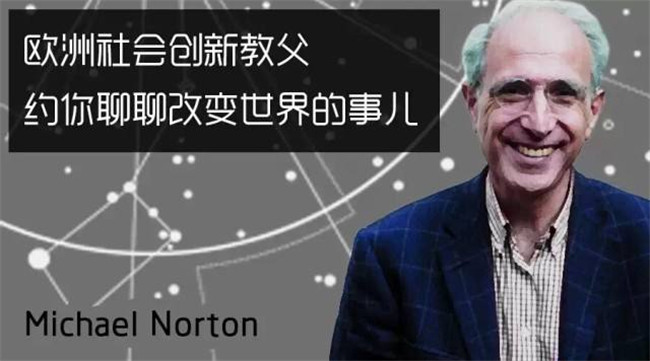
[Speaker] Michael Norton
[Time] April 5th 2017, 7pm-9pm
[Location] Room 215, Building 1, Guanghua School of Management, PKU
[Host] Guanghua-Yintai Research Center for Philanthropy and Social Impact
[Language] English
[Sign-Up]
1. http://cn.mikecrm.com/hDsTIcs;
2. Click "Read More";
3. Scan the QR Code below

Michael Norton, the pioneering UK social innovator, author and co-founder of UnLtd, has devoted most of his life to social innovation and social enterprise. Currently the Director of Centre for Innovation in Voluntary Action. In 2010, Michael’s book 365 Ways to Change the World was translated and published in China, where it quickly gained popularity among those in the social enterprise sector.

Social Enterprise In China By Michael Norton
--Interviewed by British Council and Extract from The Guardian
What were you hoping your Chinese audiences would take away from your lecture?
The main theme is that we can all change the world and we can all do something to make the world a better place. An important message is that business can become more social and contribute more to society. I think China has a strong enterprise culture and an emerging social enterprise sector, which needs encouraging and supporting. The important thing is to get started. You don’t necessarily need everyone to agree with you. If only 1% of people or businesses agree with your idea, then that is still a huge number. Just start to put your plan into action, and start making a difference. Learn as you go along, from your mistakes as well as your successes.
What is distinct about the social enterprise sector in China?
China is a multi-layered country, with government at city level, provincial level and state level. Its large population creates large opportunities. At all levels there is a growing recognition of the importance of social innovation and partnering with non-profits to deliver social services. There are also particular opportunities for social enterprises in addressing issues relating to the environment and pollution; here, technological solutions may be developed, and China could become a world leader in this.
In both China and the UK you have promoted “social franchising.” Could you tell us why?
Social franchising starts from the idea that you are helping 10,000 people, but there might be 5,990,000 who are not being helped. You are helping in one city, but there are 200 other cities where you could be providing help. In order to spread your work to meet this wider need, you need to find a suitable approach or technique for replicating your work somewhere else. There is a whole range of techniques from franchising to open source replication which you can use to spread your work.
How do you imagine the social enterprise movement will evolve in the next 10 years?
We need to encourage social impact to be at the heart of all organisations, whether they are commercial businesses or a not-for-profit. They need to be clear about what impact they can create, then focus on measuring, managing and increasing their impact. In this way, we can create big changes in society. There is a vibrant start-up sector in China, and they can build in a social enterprise approach into how they run their businesses. The business sector can use the ideas of social enterprise to do things differently and to address new needs in new markets in new ways, to provide employment for disadvantaged people, to support the local economy… and to make more profits whilst doing this. The social sector needs to become more enterprising if it is to be more sustainable and able to scale up its work. It often needs to develop a better business model and bring in more skills in marketing and selling. I’d like to see these three sectors develop the ideas of social enterprise in parallel.
Can China become a global leader in social enterprise?
One of the social investors introduced to me by the British Council told me that they want their city (Shenzhen) to become the “Silicon Valley for social enterprise”. I think this could happen, as China has the scale, the needs and access to emerging technologies. International cooperation may help this to be realised more easily. Instead of China becoming the dominant force in social enterprise, I’d prefer it if we created a global network sharing our ideas, our expertise and our experiences internationally, transnationally and bilaterally. I think the UK will remain a thought leader in social enterprise, whilst China has huge opportunities for promoting, supporting and benefitting from social innovation and social enterprise solutions. It is an exciting time to be working in China as wealth has been generated and now the challenge is to use this to address China’s social and environmental needs.
Scan to Sign-Up!!
北大拉斯维加斯9888-银泰公益治理钻研中心于2015年9月15日颁发成立,由拉斯维加斯9888与北京银泰公益基金会共同提议��������。作为国内第一个在商学院成立的公益治理钻研中心������,中心的成立承载着前瞻性、创新性与索求性——秉承拉斯维加斯9888“创造治理知识������,造就商界翘楚������,推动社会进取”的使命������,聚焦于企业社会价值与共享价值创造、社会企业与社会创新、社会影响力投资三大领域��������。
但愿通过科延注讲授和提倡等多种方式������,推动拉斯维加斯9888学院内部以及校级分歧部门在公益方面的联动������,通过整合伙源和提供专业支持������,让公益的元素融入拉斯维加斯9888的DNA傍边������,凝固各部门在此领域的协同作用������,进一步体现学院的社会责任��������。
除此之表������,中心还致力于在北大这片充斥自由与责任的地皮上造就将来的社会翘楚们意识到贸易*公益的沉要性����;推动贸易思想和现代治理技术在公益领域中的利用������,提升公益领域运营效力������,推进其可持续发展����;同时但愿影响更多企业关注社会创新与社会影响力������,参与到“立业为善(GoodBusiness)」剽一新的范式中来��������。
The Guanghua-Yintai Research Center for Philanthropy and Social Impact is the first research center established in a business school in China which promotes advance knowledge in philanthropy and social impact with business methodology and management skills, including CSR, social innovation, social entrepreneurship and impact investing.

 用户登录
用户登录 拉斯维加斯9888首页

